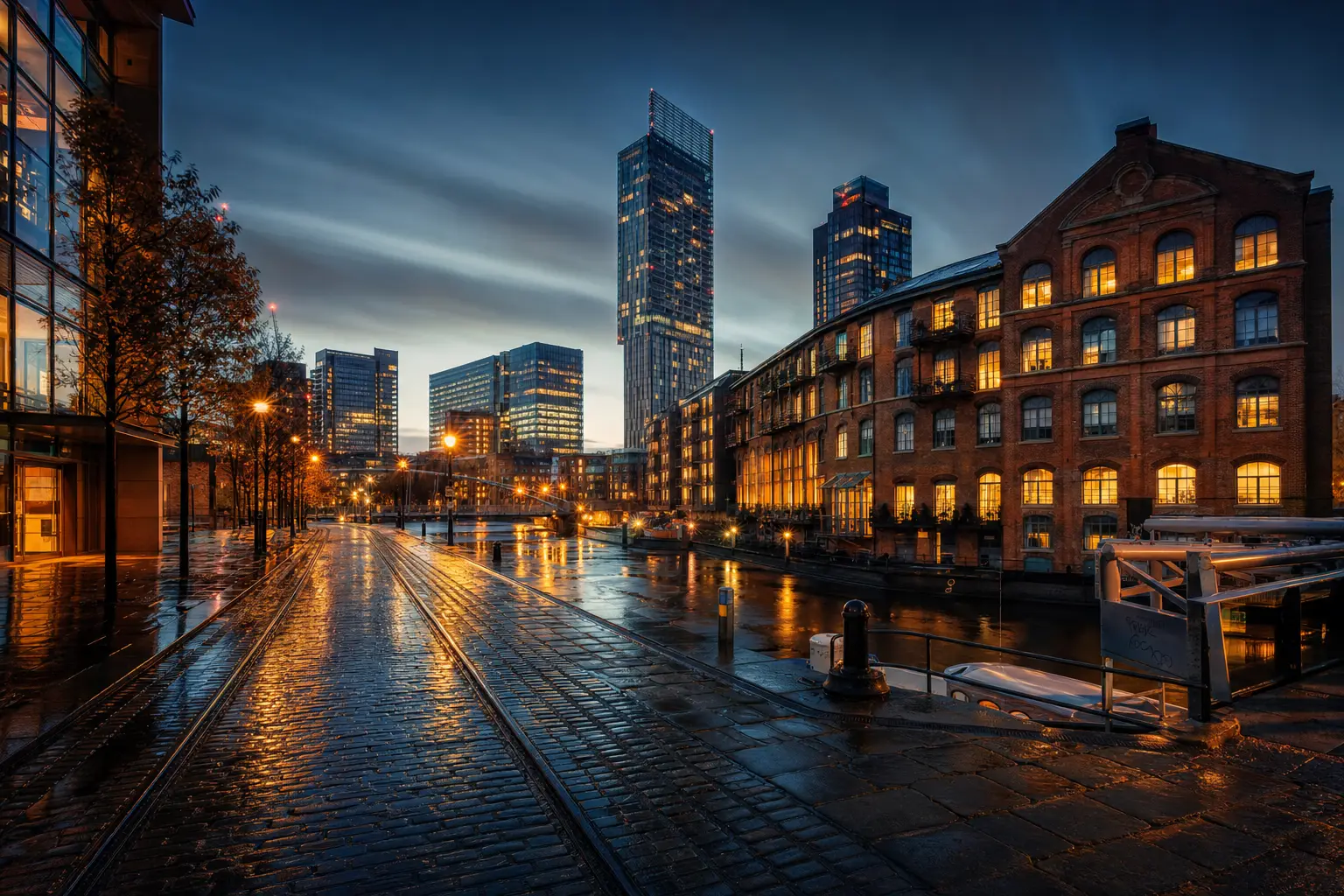
Manchester does not do things by half. The city has spent the last decade rebuilding itself into the UK’s most serious challenger to London — in tech, in media, in hospitality, in professional services, and in the kind of ambitious small business culture that most UK cities can only admire from a distance. The Northern Powerhouse is not just a political slogan. It is a lived reality for the thousands of businesses across Greater Manchester who are genuinely competing at a national level and, increasingly, an international one.
And yet. Browse the online presence of a significant slice of Manchester’s SME market and you will find something that does not match the ambition on the ground. Websites that look like they were built in 2016. Homepage copy that leads with the company’s founding year before it explains what the company actually does. Mobile experiences that frustrate rather than convert. Service pages that describe what a business does without ever answering why a client should choose them over anyone else on the first page of Google.
This is not unique to Manchester. It is a pattern common across UK cities where businesses have grown on referrals, local reputation and personal relationships — and have never really needed to make their website work hard for them. The problem is that this dynamic is shifting, and businesses that do not adapt will feel it.
The Referral Economy Has a Ceiling
Manchester is a relationship city. If you have been in business here for a few years, you know how the engine runs: a former colleague refers you, a satisfied client passes your name on, you land a contract because someone in a room remembered you from a networking event three years ago. This is a genuine asset — and one of the reasons Manchester businesses can sustain themselves without a strong online presence for longer than businesses in more transient markets.
But referrals have a ceiling. And the moment someone receives a referral to your business, the first thing they do is search for you. They land on your website. In under 30 seconds — often much less — they have formed a judgment about your business that no referral, however warm, can fully override.
This is not a question of fairness. It is how the brain processes visual information. Design quality is used as a proxy for organisational quality. A polished site signals a polished operation. A neglected site signals neglect — regardless of how good the actual service is. Research puts that first impression window at under six seconds — and it happens before a visitor has consciously decided to evaluate you.
If your best clients come through referrals and your cold enquiry rate is almost zero, your website is the bottleneck. Not your service quality. Not your pricing. The website is where the referral goes to die.
The businesses that break through the referral ceiling are the ones who have made their online presence as strong as their reputation. That combination — word of mouth that lands on a site that confirms every good thing they heard — is what moves a business from locally known to genuinely scalable.
The Three Website Mistakes Manchester Businesses Keep Making
After working with businesses across the UK and watching how they approach their digital presence, three patterns surface consistently — particularly in cities like Manchester where strong local businesses have grown without needing to win work online.
1. The homepage that says everything and means nothing
The most common version: a headline that uses the word “solutions,” a rotating banner with three competing messages, and two paragraphs of copy that explain the company’s values before they explain what the company does. Sometimes there is a mission statement. Sometimes there is a list of accreditations. Rarely is there a single, clear answer to the question every new visitor is asking: is this for me?
UK business owners often write their websites the way they write corporate brochures — starting with context and building slowly to the point. But web visitors do not read linearly. They scan. If the point is not in the first headline they see, on the version of the site that loaded on their phone, they are gone. Manchester businesses in particular — where the dominant culture is direct, no-nonsense and proud of substance over style — often underestimate how much they need to translate that directness into their digital presence.
2. Mobile as an afterthought
In 2026, the majority of first-touch website visits happen on a mobile device. For a Manchester business with any kind of social media presence, that number will be even higher. And yet the mobile experience on a significant number of local business sites remains an afterthought — images that do not resize cleanly, navigation that requires precision tapping on a commuter train, text that renders at a size that demands pinching and zooming.
This is almost always a symptom of a site that was designed on a desktop, tested on a desktop, and launched without anyone seriously checking how it behaves in someone’s hand on the Metrolink to Deansgate.
3. No clear next step
What do you want someone to do when they land on your website? If the honest answer is “have a look around,” that is the problem. Every business website exists to move a visitor from awareness to action — a phone call, an email, a booking, a case study that builds trust. If your homepage does not have one clear, prominent next step, you are leaving that decision entirely to the visitor. Most of them will not make it unprompted.
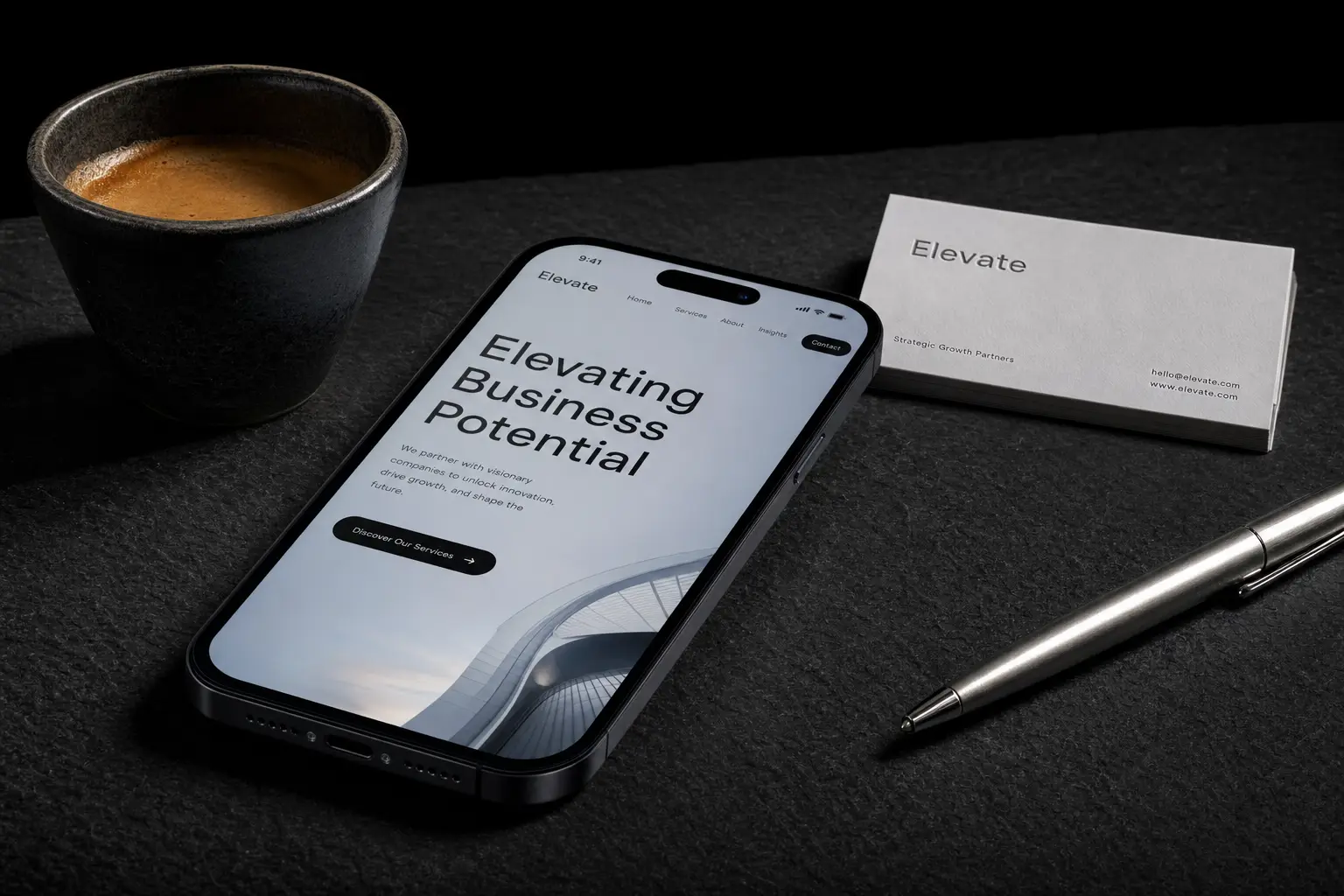
Most of your first-time visitors are making a judgment on a screen this size.
What the Best-Performing Manchester Businesses Have in Common
The Manchester businesses that successfully win clients online — not just locally, but nationally and internationally — share consistent characteristics in how they present themselves digitally.
They treat the homepage as a sales page, not a brochure. The hero section answers three questions immediately: what does this business do, who does it do it for, and why should you trust them. Everything else follows from that.
They have made a decision about who they are for. Vague positioning is the enemy of online conversion. The most effective Manchester business websites have a clear point of view — on their market, their ideal client, their approach. That specificity attracts the right people and filters out the wrong ones. That is not a limitation. That is the model.
They have invested in how the site looks, not just what it says. Visual credibility — the quality of photography, the consistency of the colour palette, the confidence of the typography — is what converts a first-time visitor into someone who reads further. Manchester businesses with strong brand identities understand this intuitively. The ones who built a website to “just get something online” often do not.
Why Staying Local Is Not Always the Best Answer
Manchester has a strong design and digital agency scene. The Northern Quarter alone has no shortage of capable studios with impressive client lists. But the agency model has economics that can work against a small or medium-sized business.
A Manchester agency with full-time staff, studio rent in Ancoats, and the full overhead of a growing creative business has costs that flow directly into your quote. Project rates of £5,000–£15,000 for a straightforward business website are not unusual for a well-regarded local agency. For a service business turning over under £1 million, that is a meaningful commitment — one that often gets deferred, cut back, or quietly abandoned when cash flow gets tight.
There is an alternative that more UK businesses are now exploring: working with remote designers, including designers based in South Africa, who can deliver equivalent quality at significantly lower cost. The exchange rate between the British Pound and the South African Rand is one of the more useful arbitrage opportunities currently available to UK small businesses — and the reasons go well beyond the exchange rate.
A website project that quotes at £8,000 from a Manchester agency can come in at £2,500–£4,000 from a comparably skilled South African designer — with the same international design standards, delivered in fluent English, with a working timezone that overlaps the UK business day almost entirely.
This is not a compromise. Post-pandemic remote work normalisation has made this practical in a way it simply was not five years ago. A designer working in Johannesburg with a Manchester client has access to the same tools, the same design references, and the same understanding of UK brand expectations. What they do not carry is the cost of a Northern Quarter studio.
A Quick Website Audit for Manchester Businesses
If you are not sure whether your current site is helping or hurting you, here is a three-minute audit you can run right now. The one rule: open your website on your phone, not your laptop. That is how most of your prospective clients are finding you.
Then answer these questions honestly:
- Can you tell, in under five seconds, exactly what this business does and who it serves?
- Is there a clear next step — a button, a call to action — visible without scrolling?
- Does this site look like it belongs to a business you would take seriously and recommend to someone you know?
- Does it load fast enough that you do not notice the wait?
- Is there any evidence — testimonials, case studies, real results — that real clients have trusted this business and been glad they did?
If you answered no to more than two of those, your website is not working for you. The question is not whether to fix it — it is how soon the cost of not fixing it will exceed the cost of getting it right.
Manchester businesses that are serious about growth have worked out that their website is not a marketing asset sitting quietly in the background. It is the first sales conversation happening without them in the room. The question is whether that conversation is going well.